



Use to summarize this article


- Contentful has three plans: Free at $0 forever, Lite at $300 a month flat, and custom Enterprise. There's nothing in between.
- Content types, not records or API calls, are the real ceiling most teams hit first. A blog, authors, categories, and a handful of page builder blocks can burn through 25 content types fast.
- Modeling SEO fields as their own content type is the single most common mistake, wasting two content types for something rarely reused across pages.
- Personalization, Studio, and AI Actions are all separate products that only unlock on Enterprise, regardless of team size.
- An 8-person team on Contentful pays the full $300/mo the moment it outgrows Free, versus a gradual per-seat climb on platforms like Sanity.
Contentful has three plans. Free costs $0 forever. Lite costs $300 a month flat. Enterprise is custom.
Here's the thing that catches people off guard: there's nothing between Lite and Enterprise. That gap is the single most important thing to understand before you budget.
This guide breaks down every rate straight from Contentful's own pricing page, including the add-ons most comparisons skip entirely.
| Feature | Free | Lite | Enterprise |
|---|---|---|---|
| Price | $0 forever | $300/month | Custom |
| Users | 10 | 20 | Custom |
| Roles | 2 (Admin, Editor) | 3 | Custom |
| Locales | 2 | 3 | Custom |
| API calls | 100K/month, hard cap | 1M/month, overage allowed | Unlimited |
| CDN bandwidth | 50 GB/month, hard cap | 100 GB/month, overage allowed | Custom |
| Content types (Starter Space) | 25 | 25 | Custom |
| Spaces | 1 Starter Space | 1 Starter + 1 optional Lite Space | Unlimited |
What you actually get on Free?
Free doesn't expire. It's genuinely built for learning and exploring the platform, not just a seven-day trial in disguise.
You get 10 users, 2 roles (Admin and Editor), and 2 locales. You also get 100,000 API calls a month and 50 GB of CDN bandwidth, both hard capped, no overage option either way.
One Starter Space comes included: 25 content types, 2 environments, 10,000 records.
Structured content, developer tools, and the editorial experience are all in there too. The limits are real, but the core platform isn't crippled just because you're not paying.
What Lite actually adds?
Lite costs $300 a month flat. No per-seat pricing, no smaller entry point to ease you in.
Users double to 20. Roles go up to 3. Locales go up to 3. API calls jump to 1 million a month, and bandwidth jumps to 100 GB.
Comments, task management, scheduled publishing, and live collaboration all show up here for the first time. None of that exists on Free.
You still only get one Starter Space. A second, bigger Lite Space is available, but it costs extra, $850 a month on top of what you're already paying.
The cliff between Free and Lite
There's no gentle ramp here. Free costs nothing. The moment you outgrow it, Lite costs $300 a month right away, with nothing smaller in between.
If your team is about to hit 10 users or 100,000 API calls, budget for the full $300 jump. It doesn't creep up gradually.
What that Lite Space add-on actually buys you?
A Starter Space is the free area every plan comes with. A Lite Space is a separate, bigger paid space you add on top.
It runs $850 a month on top of your Lite plan. For that, you get 50 content types, 4 environments, 50,000 records, and up to 5 workflows.
You also get 2 million more API calls and 750 GB more bandwidth a month, stacked on top of what Lite already gives you.
This makes sense if you're running one genuinely demanding project that needs real room. It's overkill if you just needed a bit more API headroom.
The real limit isn't records or API calls, it's content types
Most teams never come close to 10,000 records on the Starter Space, or 50,000 on a Lite Space, unless they're syncing data in from another system entirely. That's not where the pressure actually shows up.
Content types are the real constraint. A content type is any unique, repeatable document structure, a blog post, a page, an author profile. The Starter Space gives you 25. Lite Space gives you 50.
That sounds like plenty until you actually count. A blog is one content type. Authors is another. Categories is a third. You're at 3 before you've built a single page.
Now add a page builder, the kind that lets you shuffle reusable blocks on any page. The page itself is a content type. Every distinct block you want to reuse, a hero, a testimonial grid, a pricing table, is its own content type too. Ten page builder blocks alone puts you at 12, on top of whatever else you've already modeled.
Here's the mistake worth avoiding specifically. SEO fields, meta title, meta description, Open Graph title, Open Graph description, look like a natural candidate for their own repeatable content type. Don't do it. In practice, you rarely reuse the exact same SEO title and description across many pages, doing so is bad SEO to begin with, so making SEO its own repeatable type just burns two content types for something you'll mostly use once per page anyway. Model it as fields directly inside the page type instead.
Run that math across a real site, a blog, authors, categories, a handful of core page types, and a reasonable page builder block library, and 25 content types disappears fast. 50 lasts longer, but not as long as the sticker number suggests. Once you're out of room on either Space, the only path forward is a conversation with Contentful's sales team, which usually means Enterprise-level cost for what might just be a content modeling problem.
What happens once you go over your limits?
Lite doesn't cut you off the way Free does. Going over just costs you money instead.
Extra API calls run $5 per additional million a month, and Contentful waives this on some Enterprise plans. Extra bandwidth runs $0.15 per GB a month.
Free works completely differently. There's no overage option at all. You either stay under the limits or you upgrade, full stop.
The build cost that never shows up on the pricing page
For almost every team, the actual build ends up costing more than the license fee in year one. Contentful doesn't ship a theme or a template you can just switch on.
Content modeling, environment setup, the frontend build, and any migration work all have to happen before anyone publishes a single page. None of that shows up anywhere on the pricing page.
A full implementation commonly takes anywhere from several weeks to a few months, depending on how complex your content actually is. That adds up fast against $300 a month in license fees, which is exactly why the two need to be budgeted side by side, not compared as if they're the same kind of cost.

What Enterprise adds?
No published price here. Enterprise scales to custom user counts, custom roles, and custom locales, whatever your organization actually needs.
API calls become unlimited. Bandwidth becomes customizable. You get a dedicated Customer Success Manager, access to Professional Services, and support around the clock.
Governance, compliance, and security all expand too, with an uptime SLA as high as 99.99%. Spaces stop being one-plus-an-add-on and just become unlimited.
Enterprise is also the only tier that unlocks Contentful's Personalization, Studio, and AI Actions products.
Personalization, Studio, and AI Actions all cost extra
These three sit outside your core plan entirely, and none of them are available unless you're already on Enterprise.
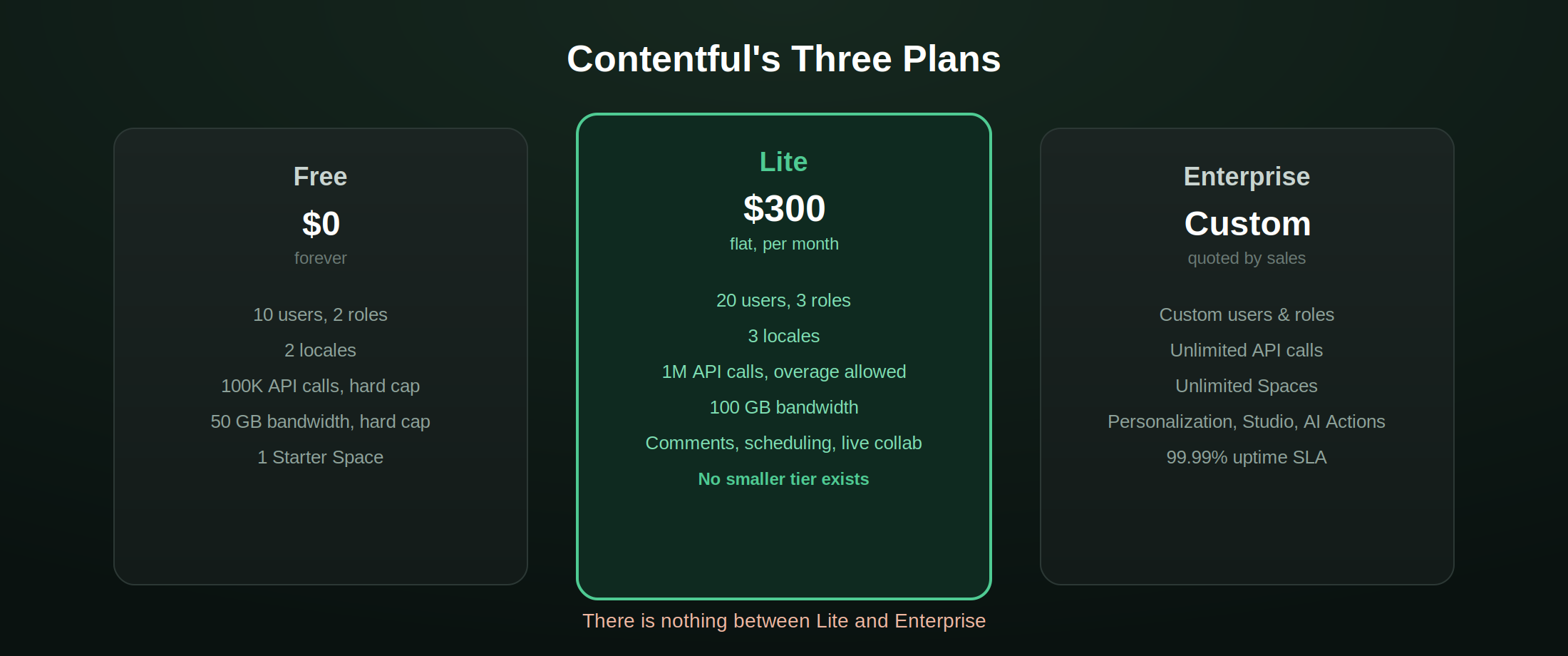
Personalization comes in three tiers. Start gives you 100,000 monthly active profiles and 100 AI Suggestions. Core bumps that to 500,000 profiles, 500 AI Suggestions, and SOC 2 Type 2 compliance. Scale goes up to 1 million profiles, 1,000 AI Suggestions, and adds single sign-on. Contentful built this out through an acquisition rather than from scratch, and it shows in how tightly it's integrated into the core editing experience compared to bolting a third-party personalization tool on afterward.
AI Actions runs on a pool of included AI credits, then either pay-as-you-go or a discounted pre-pay rate if you know your usage ahead of time. You can run it on Claude Sonnet 3.5, GPT-4o, or GPT-4o mini.
Studio gets quoted as a fully custom annual plan, straight from sales.
None of these three show up anywhere in that $300 Lite price. They only become real options once you're already sitting on a custom Enterprise contract.
Support gets better as you pay more, unsurprisingly
Free and Lite both get community resources and standard ticket support through Contentful's site. Neither one guarantees a response time.
Enterprise changes that completely. You get a dedicated Customer Success Manager, guaranteed SLA response times, support around the clock, and access to the Professional Services team when you need real implementation help.
Every tier, Free included, can join Contentful's Discord and use their Learning Center at no extra cost.
3 mistakes that quietly inflate your bill
Modeling SEO fields as their own repeatable content type is the first, and probably the most common. It eats two content types for something you'll rarely reuse in practice, and it's the fastest way to burn through a Starter or Lite Space's budget without realizing it until you're stuck.

Assuming Lite will somehow cover AI or personalization work is the second. It won't. Both need Enterprise, no way around it.
Ignoring the overage math is the third. At $5 per extra million calls, one traffic spike is genuinely cheap to absorb on Lite. Several sustained spikes every single month is a different conversation, and one worth having before it happens, not after.
What this actually looks like depending on your team?
A two-person team just validating an idea fits inside Free without a second thought. You'll rarely brush up against 10 users or 100,000 API calls at that stage.
A growing marketing team of 15 to 20 people needs Lite pretty much immediately, since Free's 10-user cap gets hit fast. Just budget the full $300 a month rather than expecting a partial step up.
Running AI-driven personalization or automated content workflows? You need Enterprise no matter how small your team is, since those features simply don't exist below that tier.
Managing multiple brands or regions? Same story. You'll want Enterprise for the custom locale count and the unlimited Spaces alone.
How Contentful actually stacks up against the alternatives?
Contentful's biggest real advantage is name recognition. It's reportedly used by a large share of Fortune 500 companies, which genuinely matters in enterprise procurement conversations where an unfamiliar vendor can be a much harder sell internally.
The tradeoff is that pricing cliff. A small team of 8 editors usually fits comfortably inside a per-seat model like Sanity's Growth plan for well under $300 a month. On Contentful, that same team hits the full $300 flat rate the moment it needs more than Free's 10 users or 100,000 API calls, regardless of how light its actual day-to-day usage is.
| Platform | Pricing Model | Entry Point | Why It Matters |
|---|---|---|---|
| Contentful | Fixed tiers, no per-seat option | $300/month flat (Lite) | Strong enterprise recognition, but a hard jump the moment you outgrow Free |
| Sanity | Per seat plus metered overage | ~$139/month for 8 editors | Scales gradually with team size instead of jumping to a fixed tier |
| Storyblok | Tiers with seat and locale caps | ~$99/month (Growth) | Cheaper entry point than Contentful for small teams |
| Strapi Cloud | Usage-based hosting plus separate license | ~$90-99/month + license | Unlimited seats, but governance features cost extra |
Storyblok and Strapi both offer entry-level paid tiers that sit below Contentful's $300 floor, which matters specifically if you've outgrown a free plan but aren't anywhere near enterprise-scale traffic yet.
Where a hybrid platform changes the math?
Contentful's pricing, like most headless CMS platforms, assumes your team is genuinely comfortable working inside a developer-oriented content model with no visual editing layer built in for marketers.
That's exactly the gap platforms like BetterCMS are built to close. Instead of a $300 flat jump with no visual editor included anywhere, a hybrid, AI-native platform bundles real, marketer-facing editing tools alongside the same structured, API-first content model Contentful is built on. If you want Contentful-level content structure without a separate frontend build and an interface only your developers can comfortably use, that changes more than just the license line on your invoice.
Which plan actually fits you?
Under 10 users, still testing things out, fine with hard caps? Free covers real evaluation work, not just a quick demo.
Past 10 users or 100,000 API calls, need comments and scheduled publishing? Lite is genuinely your only option, and it's $300 a month flat.
Need AI Actions, Personalization, or Studio? You're going to Enterprise, and your team size doesn't change that.
Running a second demanding project inside your existing Lite plan? Actually check whether you just need more API headroom before committing to the $850 Lite Space add-on.
Flowtrix has delivered 120+ website builds for B2B SaaS, AI, and enterprise brands, scoping the right content architecture for each one.

A CMS architecture built to organize a growing portfolio of services into one cohesive, easy-to-scale site, with 10x faster content updates after launch.

A content model built to serve six distinct industries from one scalable CMS, letting the team manage every industry page independently without a developer.
How Flowtrix approaches Contentful projects
Flowtrix builds structured content backends for B2B SaaS, AI, and cybersecurity companies, and Contentful gets evaluated alongside other headless platforms based on what a specific project genuinely needs: deep resource libraries, multi-locale content, and relational data that a standard CMS collection just can't hold.
Every build starts the same way, content modeling and information architecture first, then a component-driven frontend with technical SEO and schema built in from day one. The platform decision and the actual build happen together, not as two separate projects running on two separate timelines.
If you're weighing Contentful against the wider field, Flowtrix's guide to the best headless CMS platforms in 2026 covers where it fits next to Sanity, Storyblok, and the rest.
FAQ's
Common questions teams ask about Contentful pricing.













.svg)

.svg)



%201.svg)


.svg)
.svg)