For Series A SaaS companies graduating from founder-led GTM to a real marketing operation. Webflow Enterprise Certified, four to six week launch, integrations engine built for compounding organic growth.







Sound familiar, Series A CMO?
Every Series A SaaS team we talk to hits the same five problems within six months of the round. If three are true for you, the site is slowing pipeline and brand evolution.
The site looks like the seed deck still
The Series A round closed and the website still looks like the seed-stage marketing site. Series B investors will pull it up before the next pitch and quietly downgrade their interest.
Marketing was hired but cannot ship
You hired your first head of marketing. They have campaigns queued up. The site is the bottleneck on every one. Each landing page is an engineering ticket competing with product features.
Two product lines, one confused homepage
Your second product line shipped six months ago. The homepage still talks about the original wedge. Each product page is a hacked inheritance of the old IA, and prospects cannot tell what you sell.
Three new integrations, zero new pages
You signed three new integration partners last quarter. None of them have a real page on the site yet. Each one is a programmatic SEO asset you are not publishing because the CMS cannot handle it.
Customer stories live as PDFs in inboxes
You have ten customer stories. Three of them have logos on the homepage. The rest live in PDFs sales emails out one at a time. You should be filtering customer stories by ICP, not gating them in PDFs.
What changes at Series A done right
Five outcomes Series A SaaS teams notice within 90 days of launch, from compounding organic to faster integration partner activation.

Built to scale through Series C
The site we ship at Series A scales to Series B and Series C without a rebuild. CMS architecture, design system, and SEO foundation set up properly from day one. Most Flowtrix-built Series A SaaS sites are still running at Series C.
Marketing operates without engineering
Marketing publishes integration pages, customer stories, and campaign landing pages in under fifteen minutes. The site keeps up with the partnership flywheel and the campaign calendar.
Schema, AEO, and content architecture set up properly from launch. Most Series A SaaS clients see organic sessions grow 3 to 5x within six months as the content compounds.
Schema, AEO, and content architecture set up properly from launch. Most Series A SaaS clients see organic sessions grow 3 to 5x within six months as the content compounds.
An integrations engine that ranks
The integrations content engine is one of the highest-leverage assets a Series A SaaS company can build. Each page becomes a programmatic SEO asset that ranks for 'X integration with Y' searches.
One team, four to six weeks
No design-dev handoff, no separate SEO vendor. Strategy, design, build, SEO, and ongoing ops from one Webflow Enterprise Certified team. Four to six week launch, fixed-scope pricing.
How we build Series A SaaS websites
A seven-step process refined across dozens of Series A SaaS Webflow builds. Predictable timeline, fixed scope, ready to scale through Series C.
Discovery and positioning
One 45-minute call. We pull apart your positioning, your buying committee, your top three competitors, and your post-Series-A GTM motion. Output: a brief that drives every design and copy decision.
Information architecture
We map the site to your Series A buyer journey: technical evaluator, economic buyer, end user, procurement. Each gets a clear path. Multi-ICP product architecture handled cleanly.
UI and UX design in Figma
Custom design that signals Series B craft while still feeling Series A approachable. Three rounds of revision. Component-driven for fast iteration as the company scales.
Webflow development
Webflow build with proper CMS for blog, customers, integrations, careers, changelog. Sub-2-second global load. Marketing publishes new content in fifteen minutes.
SEO and AEO optimization
Schema, semantic HTML, internal linking, Core Web Vitals, AEO setup. Set up properly at launch so organic traffic compounds for the next two years.
QA and launch
Cross-browser QA, accessibility checks, performance optimization. Zero-downtime launch with full DNS and analytics handover.
Webflow Ops retainer (optional)
Most Series A SaaS teams keep us on retainer for ongoing pages, integrations, and campaign work. Same-week turnaround.
See it in action
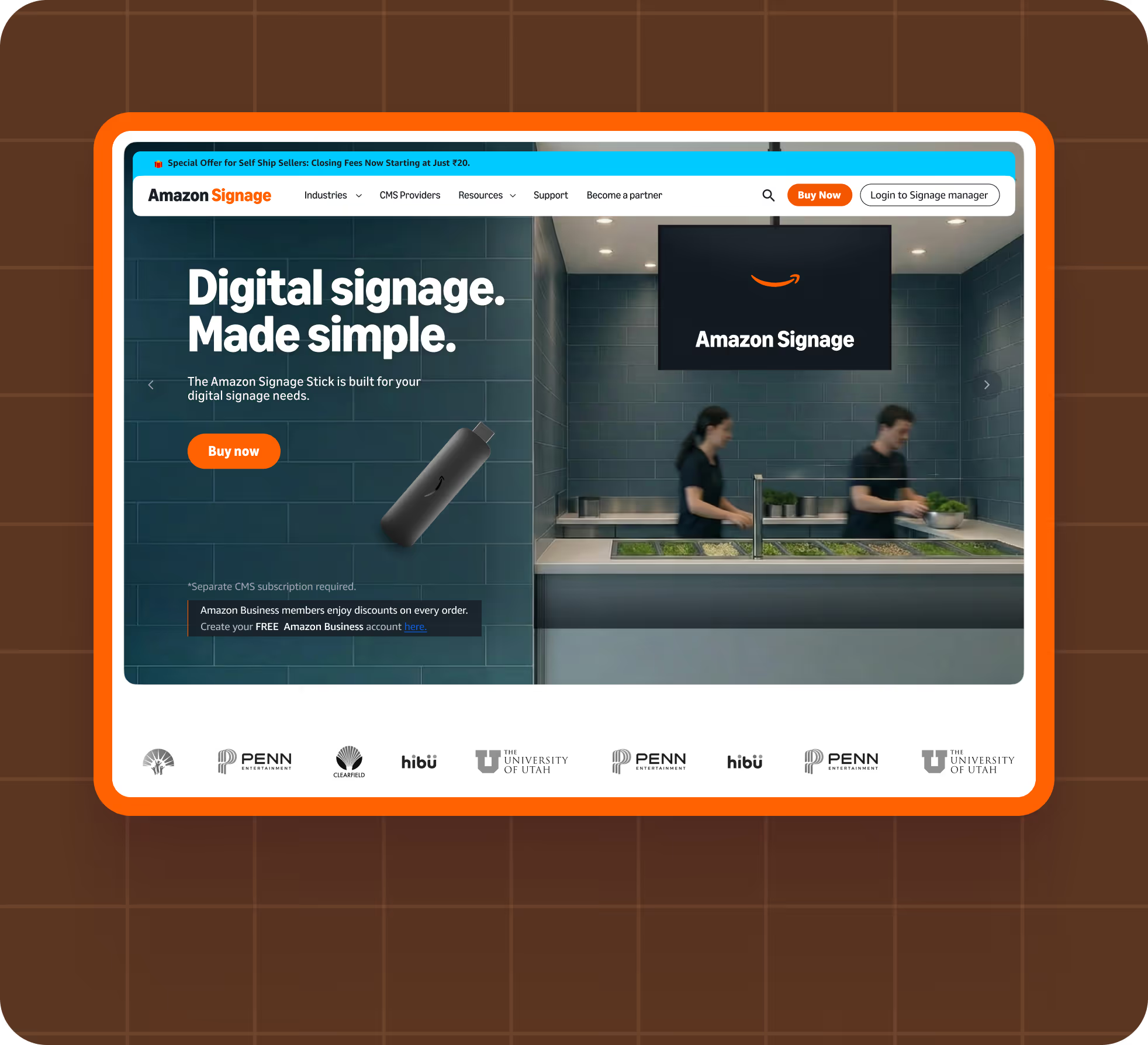

Our team revamped Amazon Signage's Webflow website, highlighting their product with an conversion focused experience.
Flowtrix built scalable Webflow components and delivered high-quality work with clear, consistent communication.

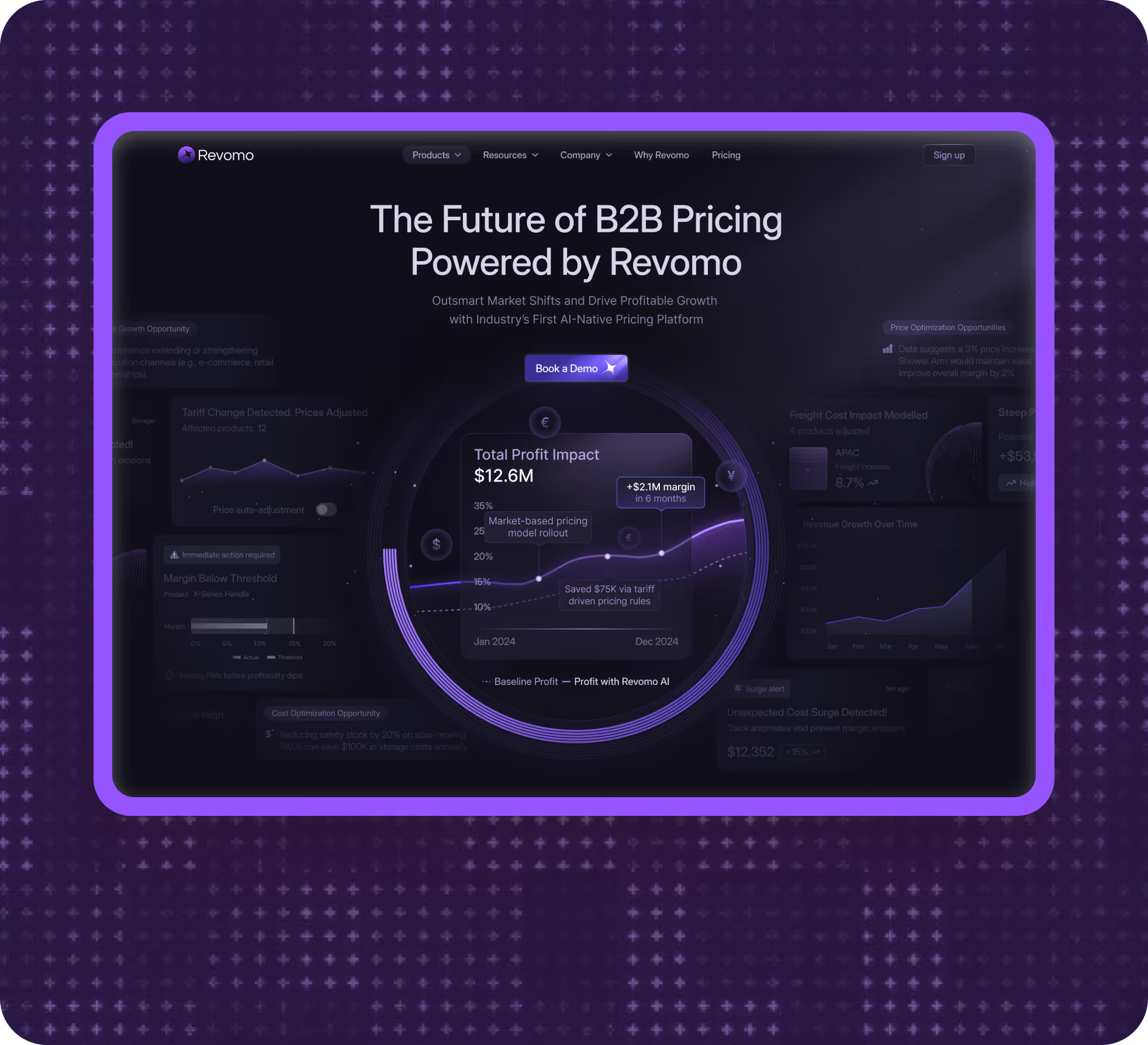

We developed a Webflow website, highlighting the use-case and features of Revomo AI and how it plays an essential role of B2B companies.
Flowtrix built scalable Webflow components and delivered high-quality work with clear, consistent communication.
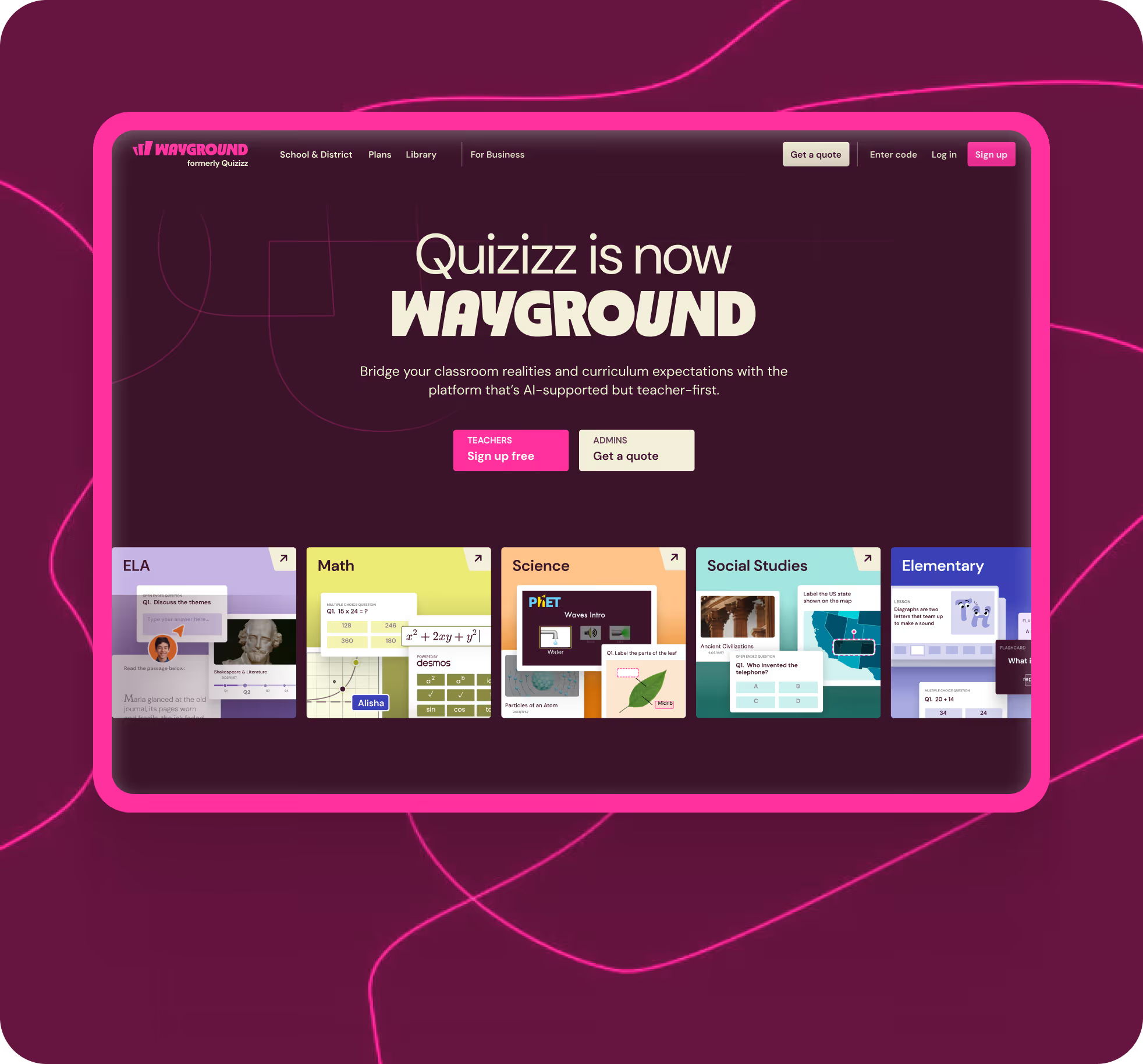

Our team led the Wayground Webflow development, showcasing their AI-powered, teacher-first platform that makes resources and assessments more accessible.
Flowtrix built scalable Webflow components and delivered high-quality work with clear, consistent communication.


Fuxam’s Webflow website presents their all-in-one, AI-powered education platform, highlighting streamlined campus management, digital learning, and exam solutions.
Flowtrix built scalable Webflow components and delivered high-quality work with clear, consistent communication.
Why Series A SaaS companies choose Flowtrix
The job of a Series A SaaS website
The Series A SaaS website has a different job than seed-stage or Series B sites. It has to graduate the company from founder-and-friends GTM to a real marketing operation. That means proper CMS architecture for blog and customer stories, integration pages built for the partnership flywheel, real product pages that handle multiple ICPs, and SEO foundations that compound for the next two years.
Why most agencies get Series A SaaS wrong
The default agency playbook treats a Series A SaaS site like a brand refresh. They deliver a beautiful homepage and call it done. Six months later, the marketing team is filing tickets to add a customer story, the integrations page is one static block, and the company is paying twice for a rebuild it shouldn't need.
The other failure mode is the Series A team that tries to ship the site themselves with their two engineers. The engineers are needed on product. The marketing site competes with product features for engineering attention and loses every time. The site stays half-built for a year.
How we approach it differently
We architect every Series A SaaS site as a system the marketing team will run for the next two years. CMS collections for everything that changes regularly: blog, customers, integrations, careers, changelog. Component-driven design so adding a new page is a five-minute exercise. SEO and AEO setup at launch so traffic compounds from day one.
The integrations content engine is the part most Series A SaaS teams underinvest in. Each integration page is a programmatic SEO asset that ranks for high-intent searches and converts buyers who already use the partner product. We architect it as a CMS collection with a clean template, so your team can publish a new integration page in under fifteen minutes when a new partnership ships.
What is included in every Series A SaaS build
- Multi-ICP product page architecture. Most Series A SaaS companies serve two or three distinct ICPs. The product pages need to handle that without becoming a confused mess.
- Integrations and customer stories CMS. Built so each integration is a programmatic SEO asset and each customer story can be filtered by industry and use case.
- Full SEO and AEO foundation. Schema markup, semantic HTML, internal linking, Core Web Vitals tuning, AEO content patterns.
- Webflow Enterprise hosting. Sub-2-second load times globally, proper access controls, infrastructure that scales through Series C.
Timeline and what to expect
Four to six weeks from kickoff for the standard scope. Series A SaaS engagements typically land between 22K and 45K dollars. Fixed-scope, fixed-price, shared after a 45-minute discovery call.




What is a use-case page and why does it matter for B2B SaaS pipeline?
A use-case page is a dedicated landing page showing how a product solves a specific problem for a specific role or workflow. Use-case pages are essential for B2B SaaS pipeline because enterprise buyers search for solutions to named problems, not products by category. A use-case page matching a buyer's exact search query — 'revenue forecasting for enterprise sales teams' — captures bottom-of-funnel intent at the moment the buyer is actively evaluating solutions. These pages consistently convert at three to five times the rate of a generic homepage visit.
How does Flowtrix build scalable use-case page systems in Webflow CMS?
Flowtrix builds use-case page systems as Webflow CMS collections so each new use case requires only a new CMS entry, not a new page build. The CMS template is designed with dynamic fields for buyer persona, problem statement, solution narrative, product screenshots or feature animations, customer quote, metrics outcome, and related integrations. A marketing team member can publish a fully designed, SEO-optimised use-case page in under 30 minutes by completing the CMS fields — with no developer involvement.
How should use-case pages be structured to rank in search and get cited by AI engines?
For traditional SEO, use-case pages need: a keyword-matched H1 ('AI-powered forecasting for revenue operations'), semantic subheadings covering the problem, the solution, and the proof, internal links to related use cases and the product page, and a clear meta title and description. For GEO, use-case pages need: a concise 'Who is this for' and 'What does this solve' section in FAQ format, FAQPage and SoftwareApplication schema markup, and entity-specific language that AI engines can extract when answering 'What is [product] used for in [role]?' queries.
How long does it take to build a VC firm website?
Most VC firm websites take 6-8 weeks from kickoff to launch. The timeline depends on portfolio size, whether you need restricted LP sections, and how much new content (team bios, thesis posts, case studies) needs to be written. Funds with content ready and decisive partners launch closer to 6 weeks; those building copy from scratch trend toward 8.
Can our team update the portfolio and thesis content without a developer?
Yes — that's the entire reason we build on Webflow. Your associate, marketing lead, or chief of staff can add new portfolio companies, publish thesis posts, add team members, and update fund information without writing code. We train your team during handover and provide a Notion playbook covering every common update.
Do you handle SEO and AI search optimization for VC sites?
Yes. We implement technical SEO (schema markup, Open Graph, sitemap structure, page speed) and AEO — content structured for AI answer engines like ChatGPT, Claude, and Perplexity. For VC firms specifically, this means your thesis content gets cited when founders ask AI assistants for investors in your space. Most VC sites are invisible to AI search. We fix that.
How do you handle LP-only sections and compliance pages?
We build restricted-access LP sections using Webflow Memberships or password-gated pages depending on your needs. Compliance content — SEC disclosures, fund formation language, IR contact — is structured cleanly so it's findable for LPs and regulators without dominating the founder-facing experience.
Do you work with India-based VC firms and global funds?
Yes. Flowtrix is based in Bengaluru and works with VC firms across India, the US, Southeast Asia, and Europe. Our team operates across timezones and most fund clients prefer async-first collaboration with weekly sync calls.





.svg)

.svg)



%201.svg)


.svg)
.svg)