


Use to summarize this article


- Most post-Series A rebrands are triggered by investor optics or a new hire wanting a flag in the ground, not by a real brand problem. That is where the money gets wasted.
- There are only three honest reasons to rebuild a brand after Series A: you pivoted your ICP, you merged or expanded product lines, or you have documented proof the brand is losing you deals.
- A refresh, a visual update without touching strategy, is the right call for most post-Series A SaaS companies, not a full rebuild.
- Hold is a legitimate answer and the most underused one, especially when you already have recognition inside a narrow ICP.
- Make the call from pipeline data and sales call feedback, not from what your new board thinks looks "enterprise enough."
You just closed your Series A. The cap table looks different, the team is about to double, and somewhere in the first ninety days a new investor or a freshly hired marketing lead looks at your website and says the sentence everyone eventually says: shouldn't we rebrand?
It is one of the most expensive sentences in B2B SaaS. Not because rebrands are always wrong, but because most of the ones triggered by a funding round solve a problem that does not exist while ignoring the ones that do. Some companies burn through $200K rebuilding a brand that was converting fine. Others let a brand that is quietly losing them deals limp along for two more years because nobody wants to be the person who breaks the thing that is "working."
Both outcomes are avoidable. This is the framework we use at Flowtrix to figure out which camp a company is actually in, before a single dollar of design budget gets committed.
Here is the part nobody likes to hear: your buyers are forming an opinion of you on the website long before they talk to anyone on your team. The site is doing the selling whether you redesigned it or not. So the question is never "do we look good." It is "is what we look like helping us close the deals we actually want." Keep that as the only scoreboard and most of these decisions get a lot simpler.
- Most post-Series A rebrands are triggered by investor optics or a new hire wanting a flag in the ground, not by a real brand problem. That is where the money gets wasted.
- There are only three honest reasons to rebuild a brand after Series A: you pivoted your ICP, you merged or expanded product lines, or you have documented proof the brand is losing you deals.
- A refresh, a visual update without touching strategy, is the right call for most post-Series A SaaS companies, not a full rebuild.
- Hold is a legitimate answer and the most underused one, especially when you already have recognition inside a narrow ICP.
- Make the call from pipeline data and sales call feedback, not from what your new board thinks looks "enterprise enough."
Why does the pressure to rebrand show up right after the round?
The post-funding rebrand is almost a rite of passage. You raise the round, you hire a head of marketing, and within a quarter someone is presenting brand concepts at the all-hands. It feels productive. It is visible. It is also, most of the time, the wrong first move.
The pressure tends to come from four places, and only one of them is a real signal.
Investor optics. New investors have money and emotion tied up in what you look like. Some carry a portfolio aesthetic. Some have strong views on what "enterprise-ready" design means. Worth hearing. Not worth building a strategy around. Their taste is not your pipeline.
A new senior hire wants a flag in the ground. A VP of Marketing or CMO arriving from a bigger company often wants to make a mark fast, and the brand is the most visible thing to change. It signals ownership. It is also, more often than not, a detour around the slower work of building demand.
Competitor envy. You raised the round, you open three competitor sites, and you feel small. Except you are small. And the competitors who look more polished than you are not automatically growing faster than you. Polish is not traction.
The product genuinely changed. This is the only one on the list that holds up, and it gets its own section below.
The trap is that all four reasons get poured into one conversation and treated as if they point the same direction. They do not. Act on the wrong one and you spend a quarter on brand instead of distribution, you confuse the customers who were already buying from you, and you push back the revenue milestones your new board now watches every month.
The Refresh, Rebuild, Hold model
After running this conversation with dozens of Series A to Series C companies, we kept seeing the same pattern: teams frame the decision as a yes or no, rebrand or do not. That framing is the first mistake. There are three distinct outcomes, and each one answers a different question.
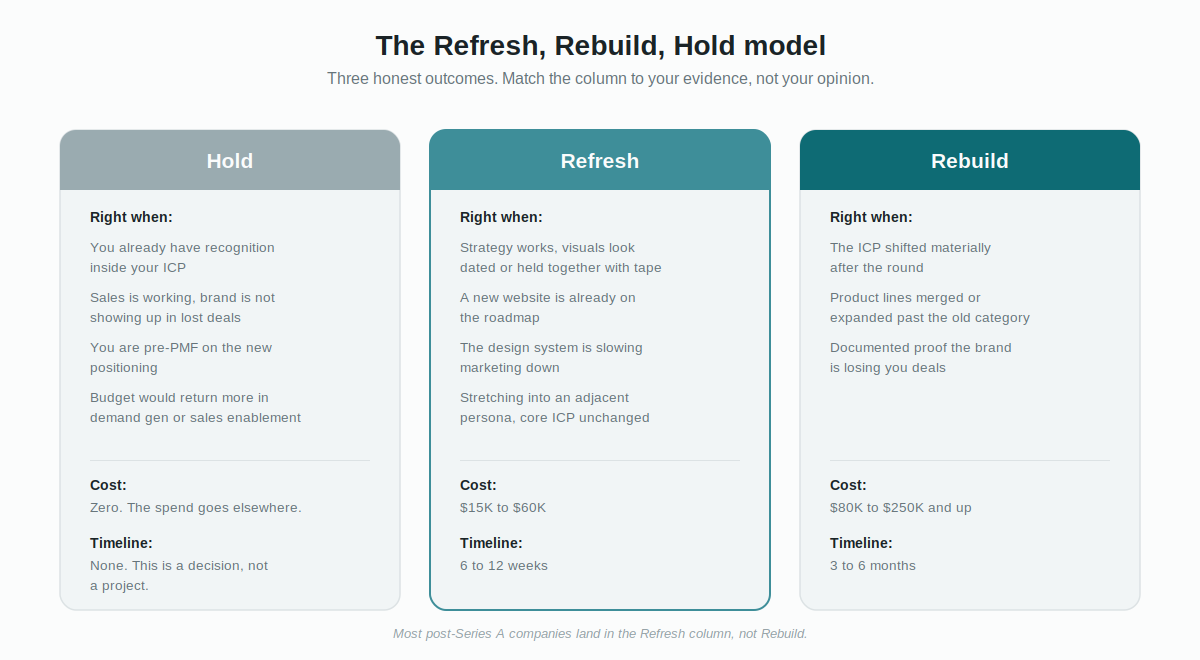
If you want the whole framework on one screen, here is how the signals map to each outcome.
| Signal | Refresh | Rebuild | Hold |
|---|---|---|---|
| Visual system looks dated but messaging is sound | Yes | ||
| ICP shifted materially after funding | Yes | ||
| Documented proof the brand is losing you deals | Yes | ||
| Product expanded from point solution to platform | Yes | ||
| Sales is working, no brand friction in calls | Yes | ||
| Pre-PMF on the new positioning | Yes | ||
| New website was planned anyway | Yes | ||
| Competitors look more polished (only reason) | Yes | ||
| Post-merger or acquisition | Yes | ||
| Budget would do more in demand gen | Yes |
What "Hold" actually means:
Hold does not mean the brand is perfect. It means the cost of changing it outweighs the return from changing it right now. And there is real money in consistency. Brand consistency research from Marq puts the revenue lift from presenting a brand consistently across channels at 10% to 20%. Every time you churn your visual identity, you reset that compounding to zero.
Hold is right when you have recognition inside your ICP and changing the brand creates risk with no matching upside, when sales is working and brand is not showing up as a factor in lost deals, when you are pre-product-market-fit on the new positioning, or when the budget a proper rebrand would eat would return more if you pointed it at demand gen, sales enablement, or product marketing instead.
What a refresh actually includes:
A refresh means changing how the brand looks without changing what it means. New typography, a tighter color system, a redesigned site, cleaner visual language. The positioning, the messaging, and the ICP all stay where they are.
Most companies that come to Flowtrix after a Series A do not need a rebuild. They need a sharp refresh that brings the visual layer up to the level the product and team have already reached. A well-scoped refresh at this stage usually covers a refined typography and color system that feels intentional instead of accidental, a redesigned website with clearer homepage messaging and faster load performance, updated visual language for sales decks so the whole funnel matches, and possibly a logo refinement, not a replacement, that modernizes without throwing away the recognition you have already built.
What it does not include: new positioning, a new ICP definition, new product naming, or a new messaging architecture. The moment those enter scope, you are not doing a refresh anymore, and the timeline and budget need to say so.
A refresh usually runs six to twelve weeks and lands somewhere between $15K and $60K depending on scope. It is a tightening operation, not a reset.
What justifies a rebuild:
A rebuild means going back to positioning, ICP definition, messaging architecture, and visual identity from first principles. What comes out the other side shares DNA with the old brand but operates as a different strategic asset.
A rebuild is justified when at least one of three things is true. You pivoted your ICP after the round, meaning you raised seed selling to SMB and your Series A thesis is mid-market enterprise. Your old brand is not broken, it is pointed at a person you no longer sell to. You merged or significantly expanded product lines, and a brand built for a single point solution talks differently than a brand built for a platform. Or the brand is actively losing you deals and you can prove it, with evidence from call recordings, lost-deal reviews, or win-loss interviews showing prospects discount you because of how you present, not because of product or price.
A rebuild usually takes three to six months and runs $80K to $250K and up, depending on agency, scope, and whether the website build is included.

Here is the cleanest test we know. If you could drop your current messaging into a better-designed website and that site would perform better, you need a refresh. If the problem is what you say, not how it looks, you need a rebuild. Almost nobody needs both at once.
How do you figure out which bucket you are actually in?
This is where most companies skip the work. They form an opinion in a room full of executives and start the project. What comes out reflects internal politics, not what is happening outside the building. Run four diagnostics before you make the call.
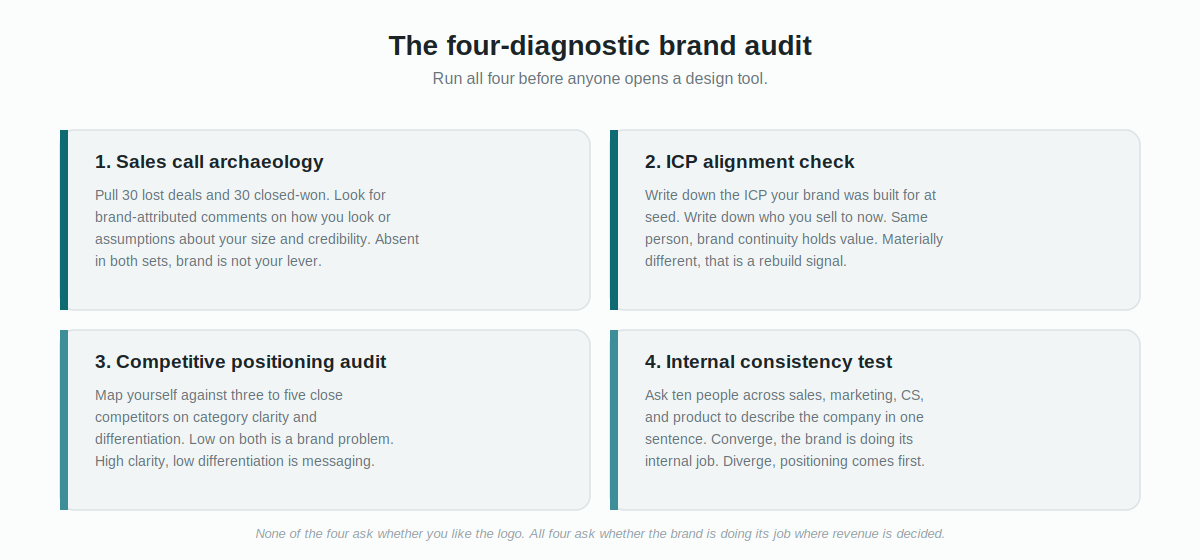
Sales call archaeology means pulling your last 30 lost deals and 30 closed-won and looking for brand-attributed signals: comments on how you look, assumptions about your size or credibility from the site. Absent in both, brand is not your lever. Present in the losses, you have your answer.
ICP alignment check means writing down the ICP your brand was built for at seed, then writing down who you actually sell to now. Same person, brand continuity is valuable. Materially different size, persona, or vertical, that is a rebuild signal, not a refresh one.
Competitive positioning audit means mapping yourself against three to five close competitors on two axes: category clarity and differentiation. Low on both is a brand problem. High clarity, low differentiation is a messaging problem a refresh can fix.
Internal consistency test means asking ten people across sales, marketing, CS, and product to describe the company in one sentence. Converge, your brand has done its internal job. Diverge, you have a positioning problem to solve before any design starts.
Notice what these four have in common. None of them ask whether you like the logo. If you cannot point to a diagnostic that failed, you do not have a rebrand case. You have an opinion.
Flowtrix has delivered 120+ revamps for B2B SaaS, AI, and cybersecurity teams. Explore the work behind the messaging.




Sharper messaging for a product that had outgrown its old site, through a full rebrand and Webflow Enterprise migration.
What are the three ways SaaS companies blow the execution?
Getting the diagnosis right is half the job. The other half is execution, and this is where well-reasoned decisions still fall apart.
- Rebranding for a buyer you do not sell to yet: After the round it is tempting to design for the enterprise logo on the two-year roadmap instead of the mid-market buyer you need to close next quarter. The result signals credibility to someone who will not evaluate you for 18 months while confusing the buyer who is in your pipeline right now.
- Splitting brand from the website build: Many companies hire a strategy shop for positioning and identity, then hand the assets to a separate web team. You get a brand that looks great in a PDF and mediocre on the actual page buyers visit. The website is not brand collateral. It is the brand.
- Launching before sales is ready: A rebrand with no updated decks, case studies, battlecards, or messaging guidance for the sales team is a marketing exercise that does not close anything. Launch day is the start of a sales enablement sprint, not the finish line.
On the first one, the fix is simple to say and hard to hold to: build the brand for where your pipeline lives today, with just enough room to grow that you are not rebuilding again in eighteen months. Designing for an aspirational buyer is how you end up with enterprise aesthetics, vague platform language, and zero case studies from the segment you claim to serve.
If you do need the rebuild, sequence it properly
For the companies that genuinely need a strategic rebuild, the order of operations matters more than the agency you pick. Skip a layer or run them out of order and every later decision sits on a shaky foundation.
What should you tell your investors?
Investors who push for a rebrand right after the close are usually working from aesthetics, not strategy. That is a normal human reaction to writing a large check. You want the thing you funded to look like it deserves the money.
The move is not to dismiss the feedback. It is to put it in a diagnostic frame. Something like: "We are running a structured brand audit over the next 30 days, including win-loss analysis and competitive positioning mapping. We will bring a recommendation with business rationale to the next board meeting."
That does three things at once. It pulls the conversation out of opinion territory. It signals operational maturity. And it buys you 30 days to either build the case for the work or kill the conversation with data.
The framework does not get easier with more funding rounds. It gets applied more often, by companies who learn the hard way that a rebrand is a strategy decision wearing a design budget. Run the diagnostics, name the bucket you are actually in, and spend accordingly.


FAQ's





.webp)






.svg)

.svg)



%201.svg)


.svg)
.svg)