







Use AI to summarize this article




You raised the round. The product works. You have customers with logos worth showing. And then you open your competitor's website and realize you could swap your homepage headline with theirs and nobody would notice.
That is the Series B messaging problem in one sentence.
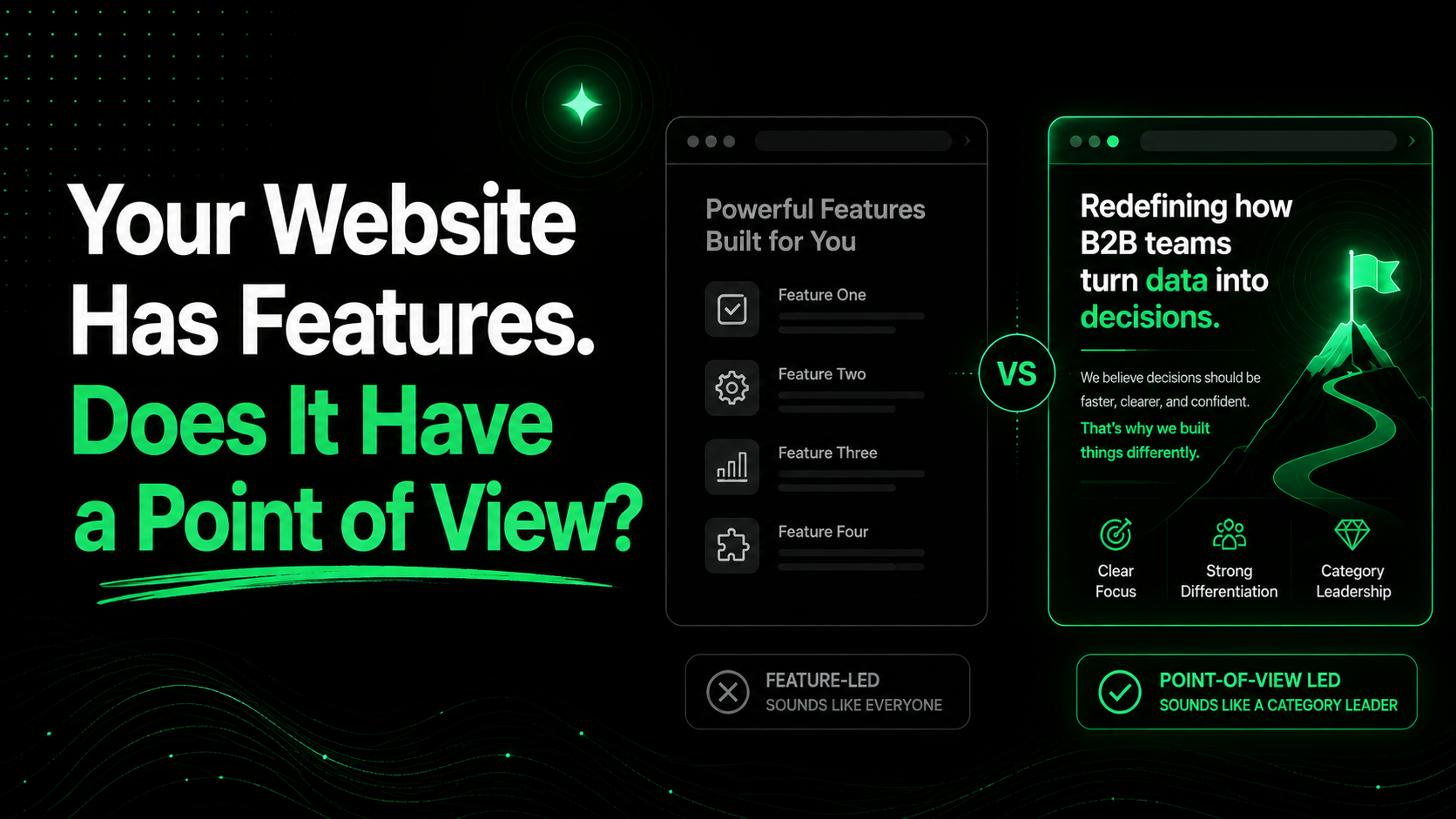
It is not a design problem. Most Series B sites look fine. The layout is clean, the palette is on-brand, the scroll animations cost someone a week. The problem is what the words say. Or more accurately, what they fail to say. At this stage, feature-led messaging has a ceiling, and most companies are hitting it right when the sales motion demands the website do more work, not less.
This is the inflection point. And the companies that navigate it correctly stop being one option among several and start being the one prospects call first.
Why Feature Messaging Has a Shelf Life
At seed stage, features are legitimately the story. You built something that did not exist. The product is the news. Writing about it directly makes sense.
At Series A, features still carry weight because you have started differentiating from the incumbents. You have capabilities they do not. The feature story still has legs.
By Series B, that story has expired. The incumbents shipped versions of your differentiating features. Newer entrants shipped variations of them too. The thing that justified your existence two years ago is now a line item on every competitor's comparison page.
Here is the shift that matters: enterprise buyers at $30K to $150K ACV are not making spreadsheet decisions. They are making organizational decisions. They are asking whether your company understands their problem deeply enough to be a long-term partner. Whether the way you think about the problem matches how their leadership team thinks about it. Whether their team will get behind it.
Those are category questions. Feature lists do not answer them.
A 2023 Gartner B2B buying study found that 77% of enterprise buyers describe their most recent purchase as "extremely complex or difficult." They are not looking for the tool with the most features. They are looking for the vendor who makes the decision feel obvious.
The Four Ways Series B Sites Fail
Before the fix, the diagnosis. The failure pattern is consistent across SaaS categories. Most Series B sites have the same four problems.
The Capability Headline
"The all-in-one platform for revenue operations." "AI-powered pipeline management for modern sales teams." "The operating system for enterprise customer success."
These headlines describe a category of tool, not a specific outcome. They could be swapped between competitors without anyone noticing because they were written to be broadly applicable. And being broadly applicable means being memorable to nobody.
A capability headline tells the buyer what the product is. A category-defining headline tells the buyer what changes about their world when the problem gets solved.
The Feature Icon Grid
Six to eight feature icons. One-line descriptions. Automation. Analytics. Integrations. Collaboration. Reporting.
Feature grids exist because they are easy to build and easy to update. They are also the fastest way to make your homepage look identical to every competitor in your space. Your prospect's brain registers "table stakes" and scrolls past.
Every feature in that grid is in your competitor's grid too. The comparison does not favor you. It commoditizes you.
Wide but Shallow Social Proof
Forty logos. Zero stories. A testimonial that says "This tool has changed how we work" from someone with a title but no context about what changed, by how much, or what it meant for the business.
Logo walls signal customer volume. They do not signal customer outcomes. At Series B, buyers expect volume. What they are actually trying to figure out is whether you consistently deliver on the specific thing you are claiming. That requires depth, not width.
No "So What"
"Real-time pipeline visibility" with no sentence about what that actually changes for a VP of Sales at a 200-person company. "Automated onboarding workflows" with no acknowledgment of what the manual alternative costs and what it means for a CS team of eight.
The "so what" is the commercial translation of a feature. It is the sentence that connects product capability to business outcome. Most Series B sites skip it entirely, leaving the prospect to do that translation themselves. Some do. Most do not.
What Category-Defining Messaging Actually Means
The phrase gets used loosely. It does not mean inventing a new category name. It does not mean writing a manifesto about the future of your industry.
Category-defining messaging means owning the problem frame. When you own the problem frame, you define what the problem actually is, why it exists, what happens when it is left unsolved, and what the right solution has to look like. When you do that well, every competitor, including ones with more features, more funding, or more brand recognition, looks like they are addressing a symptom rather than the root cause.
The test is simple. Does a prospect read your homepage and think "this is exactly how I describe this problem internally"? Not "this is a product that solves my problem." The first response. If you get the second, you have a feature list with good design.
The commercial difference between those two responses is not subtle. Companies that earn the first response get called first in an evaluation, get referenced in internal conversations before a formal process even starts, and get positioned as the standard against which alternatives are measured.
The Four Elements of a Site That Actually Works at Series B
1. The Problem-First Hero
The category-defining hero does not lead with the product. It leads with the problem, stated in the exact language the target buyer uses internally when they talk about what is broken.
The structure: name the problem, establish why it exists, state the consequence of leaving it unsolved, then introduce the product as the structural answer.
A capability hero says: "The AI platform for revenue forecasting."
A problem-first hero says: "Your revenue forecast is wrong. Not because your team is bad at their jobs, because your CRM data is 60% incomplete and everyone knows it. We give revenue leaders a forecast they can actually defend."
The second version is longer. It is also the version that makes a VP of Revenue stop scrolling.
One practical test: read your hero section to someone who fits your ICP and ask them, "does this sound like how you describe the problem internally?" If they say "mostly, but we would say it more like..." use their words. Not yours.
2. The Before/After Narrative
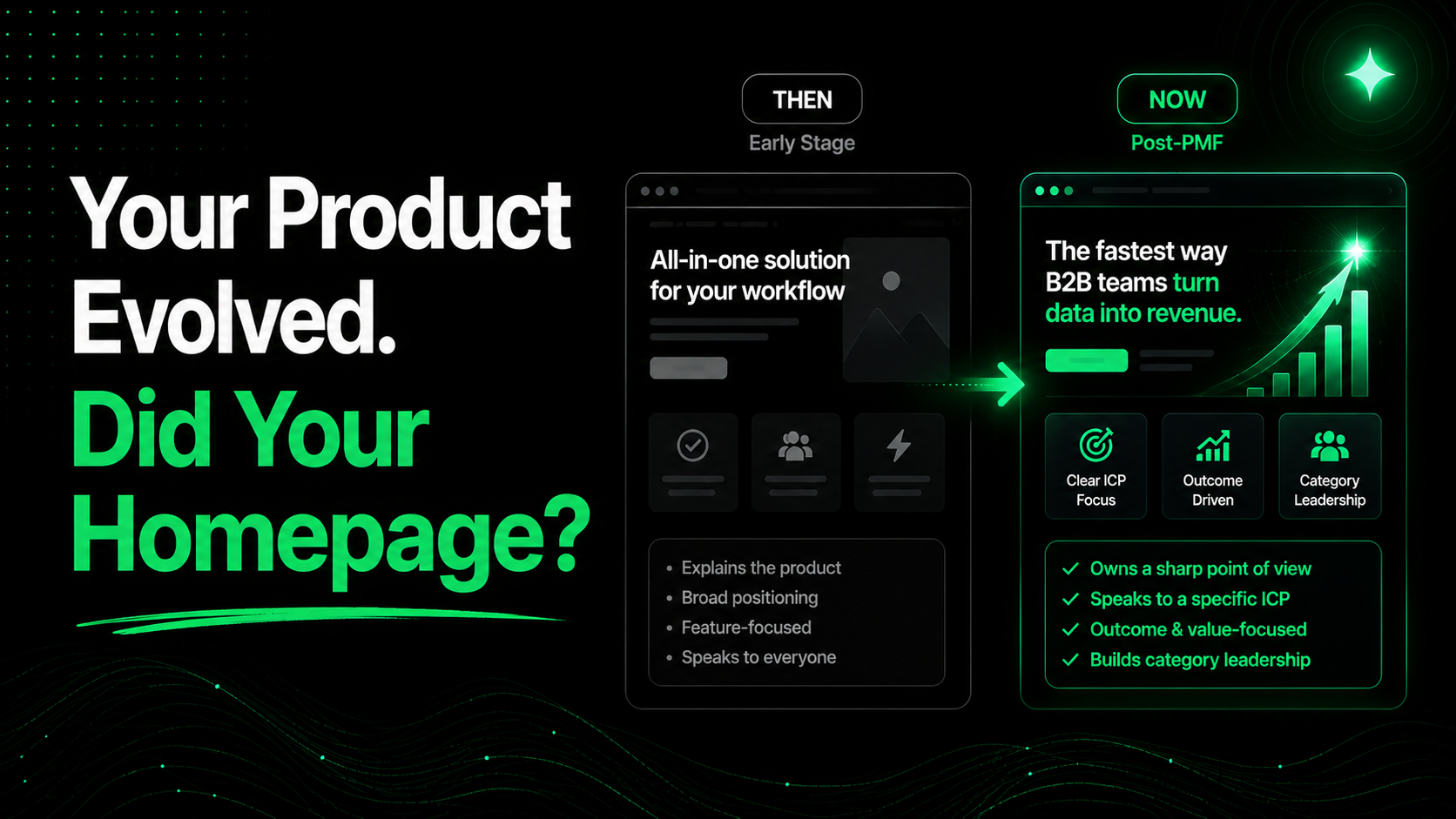
Category-defining sites do not describe features. They describe transformation. The most effective structure is an explicit contrast between the world the buyer currently lives in and the world they access with your product.
The before state should be uncomfortably accurate. Not "teams struggle with efficiency." Specific: "Your CS team is running churn analysis in Sheets because your CRM's reporting can't cross-reference usage data. You find out a customer is at risk when they tell you they're not renewing."
The after state should describe outcomes, not features. Not "real-time usage analytics." The outcome: "Your CS team knows a customer is drifting 47 days before the renewal conversation, with enough time to do something about it."
This contrast should be on the homepage, not buried in a product page. It is the core commercial argument for why the product exists.
3. Outcome-Anchored Social Proof
Social proof at Series B needs to do more than signal volume. It needs to demonstrate that the company consistently delivers the specific outcomes claimed in the positioning.
Three components make it work. First, the before context: a one-sentence description of the situation the customer was in, including company size, role, and the specific problem they were trying to solve. Second, a quantified outcome with a timeframe. Not "improved efficiency." The number: "Reduced time-to-close by 18% in the first quarter. Increased forecast accuracy from 61% to 89% within 90 days." Third, strategic commentary from the customer about why it matters beyond the metric: "We went from a forecast the board questioned every quarter to one we use to make hiring decisions. That is a different kind of company."
According to Forrester's B2B Buying research, 74% of enterprise buyers say quantified business outcomes in vendor case studies are "very important" or "critical" to their final vendor decision. Outcome-free testimonials are actively discounted by procurement teams at this ACV range.
Three case studies built to that standard outperform forty logos in any high-stakes evaluation.
4. A Structural Competitive Wedge
A comparison table with checkmarks is something any competitor can mirror in 48 hours. It is also an implicit concession that the competition is real and the decision is a features contest.
A structural competitive wedge is different. It defines why the architectural approach of your product produces outcomes that alternative approaches cannot, regardless of how many features they add.
It is not "we have feature X and they don't." It is "our approach to the problem is fundamentally different in a way that makes certain outcomes possible that are not achievable with point solutions or bolt-on features."
Some examples of this framing done well:
"Most revenue platforms sit on top of your CRM and report on what happened. We are built underneath it, which means we can change what gets captured before the data becomes stale."
"Every other CS tool shows you lagging indicators: NPS scores, support tickets, renewal dates. We instrument the product layer directly, so we see behavioral signals 90 days before those lagging indicators surface."
"Competitors in this space are workflow tools. We are a data model. Workflow tools change how your team works. A data model changes what your team knows."
None of those name a competitor. Each one implicitly defines why alternatives are inadequate at a level no features comparison can reach.
This Is a Strategy Decision, Not a Marketing Decision
The companies that fail at this make one consistent mistake. They hand the brief to a content team or a web agency and ask for "better messaging." The output is better copy layered on unresolved strategic questions. It looks sharper for six weeks and converts at the same rate it did before.
The companies that get it right run the positioning conversation at the executive level before any creative work starts. Four questions need real answers before a wireframe gets drawn.
Who is the primary buyer and what are they actually responsible for?
Not a persona. A specific description of the person whose bonus depends on solving this problem, what they get measured on, and what "success" looks like in their annual review.
What is the insight we have about this problem that our competitors do not?
This is the hardest question. It is the answer to "why does this problem exist and why have other solutions not solved it?" If the company cannot answer this clearly, the category messaging will be generic.
What is the organizational consequence of the problem?
Not "teams waste time." The specific consequence: the decision that gets made wrong, the cost that accumulates invisibly, the opportunity that gets missed.
What does the world look like when this is structurally solved?
Not a list of product capabilities. A description of how the organization operates differently, what becomes possible that was not possible before, and what the buying team can point to twelve months later as evidence the investment was right.
Those four answers produce the positioning brief. The positioning brief produces the messaging. The messaging produces the website. That sequence, business strategy to positioning brief to messaging to website, is the only one that produces a site that actually moves the needle at Series B.
How to Audit Your Current Site Before Rebuilding
Before committing to a full rebuild, run this audit on your current site. It tells you whether you have a messaging problem, a design problem, or both. Three or more red signals means the messaging-led rebuild is the right investment before your next fundraise or enterprise sales push.
The questions to check: Can someone explain what your company does in one sentence after reading the homepage? Does your hero name a specific problem with a root cause, or does it describe a product category? Are your case studies quantified with timeframes and named customers? Does your homepage answer "why not a competitor" without naming one? Is your copy specific to one ICP or written for everyone?
One more to add that most agencies do not check: does your company appear in ChatGPT or Perplexity when someone searches your category? AI search engines are now part of the B2B buying journey. A site rebuilt with category-defining language, FAQ sections built around buyer questions, and outcome-specific case studies gets cited in AI-generated answers. A site that still reads like a feature list does not.
What the Messaging Shift Actually Looks Like
Three patterns across SaaS categories, showing where feature messaging ends and category messaging begins.
Revenue intelligence: Feature messaging says "AI-powered forecasting for revenue teams. Real-time pipeline visibility, automated CRM updates, and rep coaching in one platform." Category messaging says "Revenue leaders spend 40% of their week managing a forecast they do not trust. That is not a data problem. It is a data capture problem, and no amount of AI on top of incomplete CRM data fixes it."
Customer success: Feature messaging says "The complete customer success platform. Health scores, playbooks, renewal tracking, and QBR automation in one place." Category messaging says "Churn does not happen at renewal. It happens 90 days before your CS team finds out. Every CS tool on the market tells you what already happened. We tell you what is about to happen, with enough lead time to change it."
HR tech: Feature messaging says "People analytics for modern HR teams. Engagement surveys, performance tracking, and workforce planning in one dashboard." Category messaging says "HR teams are the last function in a company to get predictive data. Finance has models. Sales has pipeline. Operations has inventory forecasts. We give People teams the same predictive infrastructure so they are making workforce decisions with the same confidence as every other executive in the room."
In each case, the category messaging names a problem larger than a product category, identifies the root cause rather than the symptom, and positions the product as the structural answer. Feature lists are absent because they are no longer the argument.
The companies that get this right are not spending more on design. They are spending more time on the strategic question that precedes the design brief: what do we actually believe about this problem that nobody else is saying clearly?
Answer that, and the website writes itself. Skip it, and no amount of redesign helps.




.avif)





.svg)
.svg)

