








Use AI to summarize this article




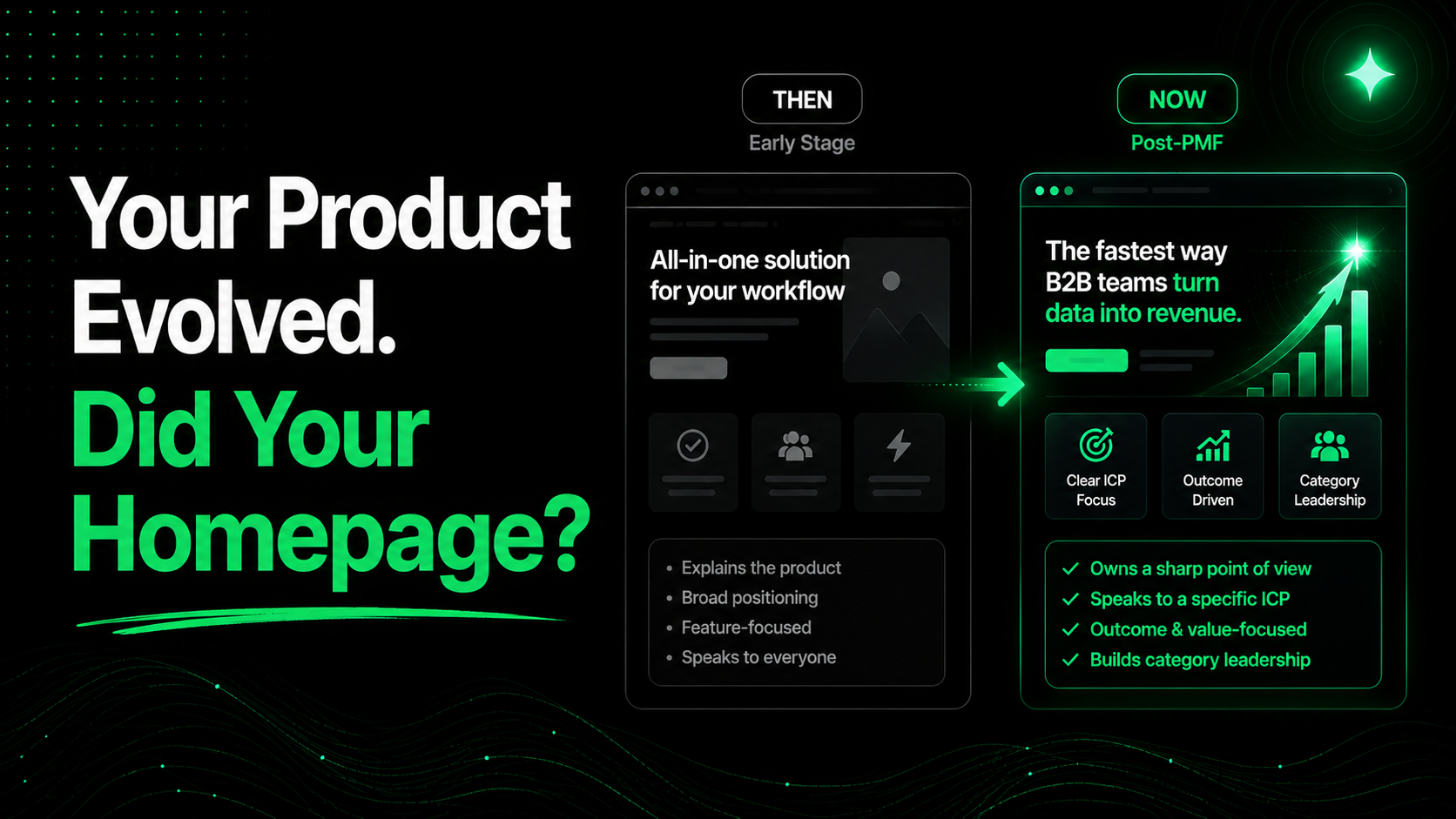
There is a version of your homepage that got you your seed round, and it was probably good. Broad market, a founding team people wanted to bet on, a product vision that felt inevitable, and just enough traction to prove you were not making it all up. It was honest about what you had and ambitious about where you were headed. It worked.
Then you spent a year building, selling, and getting things wrong in useful ways. Some of the customers you were sure would love the product did not renew. A few you never targeted turned into your best accounts. The use case you built for is not quite the use case people are paying for. The person you thought signed the contract turned out to be the champion, and the real signer was someone you only met on the third call.
You have been finding product-market fit. Slowly, messily, correctly. And your homepage still says exactly what it said the morning after the seed wire cleared.
This is the most common and most expensive messaging gap in early-stage SaaS. Not because the old homepage is badly written. Because it is no longer true. The company moved and the website did not.
This piece is a framework for how homepage messaging should change from seed through Series A. Not as a design refresh, but as a reflection of what you actually learned about who buys, why they buy, and what changes for them once they do.
Why your homepage always lags the business by 6 to 12 months
Before the framework, it helps to name why this gap shows up in almost every company, including the well-run ones.
You are too close to see it. From inside the building, PMF feels like a string of tiny adjustments. A small pivot in who you target. A repositioned use case. A redefined value metric. None of these feels big enough to justify rewriting the site. Stack twelve months of them together and you are a meaningfully different company, but no single change ever triggered the rewrite.
The website loses every priority fight. Between seed and Series A you are building product, closing deals, making your first hires, and managing a board, often in the same afternoon. The site sits at the bottom of every sprint and gets touched last, if at all.
Changing it feels like bad luck. Once a homepage has converted a handful of customers, founders get superstitious about it. Touching the headline feels like tempting fate. So instead of rethinking it, you bolt things on. A new feature callout here, a fresh logo there, until the page is a pile of additions with no spine.
PMF itself is fuzzy. The 40% test gives you a number. It does not tell you what that number means for your headline. Most founders feel the signal. Almost none of them know, on instinct, what the homepage should say on the other side of it.
The rest of this article makes that part explicit.
The three messaging stages
Early-stage messaging moves through three stages that track your progress toward fit: Pre-PMF, PMF Signal, and PMF Confirmed. Each one needs a different page structure, a different hero, and a different kind of proof. Most of the damage happens when a company is operating in one stage while its homepage is still written for the one before it.
Stage 1: Pre-PMF, the hypothesis homepage
What is happening in the business: you have a thesis about who has the problem and what the fix looks like. You have a few early customers, usually friends, former colleagues, or warm investor intros, and you are not sure the pattern holds beyond your own network. Revenue exists. Churn is unpredictable. You are still learning which use cases actually stick.
What the homepage should do: at this stage the homepage is a recruiting tool, not a conversion machine. You are recruiting early adopters and the kind of operator who wants to help build the thing, not closing six-figure enterprise deals. So it needs enough specificity to attract the right early users and enough vision to attract the people who want in early.
The structure that works at Pre-PMF:
- Hero: the problem, who it is for, and what you are building. Not a feature list. A clear statement of the gap in the market and why now is the moment to close it.
- How it works: three steps or three core functions. Enough to prove the product is real and the thinking is sound.
- Early proof: a few logos or quotes if you have them, named or not. The bar is "real people use this," not "enterprise case study."
- The team: at this stage the team section does more work than the social proof section. Early adopters and seed investors are betting on the people. Make the founding story easy to find.
- CTA: low friction. Request access, join the beta, get early access. Save "book a demo" for when the demo flow is actually ready.
What to avoid at Pre-PMF: fake enterprise polish. A hero that sounds like a mature company when you have eight customers reads as a founder optimizing for appearances instead of learning. Sophisticated early adopters and good seed investors treat that polish as a warning sign, not a strength.
Stage 2: PMF Signal, the pattern homepage
What is happening in the business: you have somewhere between 15 and 40 customers. A subset of them are genuinely into it. They use the product weekly, they refer people, and they would be annoyed if it disappeared. A pattern is forming: a specific type of company, a specific role, a specific trigger that brings them to you. It is not airtight yet, but it is real. Revenue is growing, and the churn you do see is concentrated in customers who never fit the pattern in the first place.
This is exactly where the Sean Ellis test earns its keep. Survey your active users and ask how they would feel if they could no longer use the product. If 40% or more say "very disappointed," you are in or near PMF territory. Below that line, you are still searching.
What the homepage should do: start reflecting the pattern before it is fully confirmed. This is the stage where most founders freeze. They keep the broad, everyone-welcome messaging because narrowing the ICP feels premature and scary.
Narrowing is the right call here. The pattern your best customers share is the signal. The homepage should speak to that pattern clearly enough that the wrong buyer rules themselves out and the right buyer feels recognized on sight.
The structure that works at PMF Signal:
- Hero: a specific problem for the emerging ICP. Not "teams," a role. Not "businesses," a company profile. Specific enough that your best customer reads it and thinks "that is exactly the thing I was dealing with."
- Social proof: shift from logo walls to testimonials from customers who fit the pattern. Two or three named, attributed quotes from your best accounts beat twelve anonymous logos at this stage.
- How it works: rewrite it around the use case your best customers actually use, not the full feature set. Show the one workflow that drives the value.
- Who this is for: make the ICP explicit. "Built for [role] at [company type] who [trigger]" beats trying to hint at it through subtext.
- Early outcomes: you probably have two or three customers with real numbers now. Surface them. Even rough ones, "cut X by Y%," beat "improves efficiency" by a mile.
- CTA: you can move from beta access to demo or trial here, depending on readiness. The goal shifts from recruiting inbound to qualifying it.
What to avoid at PMF Signal: updating the homepage every time you close a deal. The temptation is to add each new logo and each new use case as proof. Resist it. The homepage should reflect the pattern, not the inventory. You are still testing whether the pattern holds, and stuffing the page with every win blurs the exact signal you are trying to sharpen.
Stage 3: PMF Confirmed, the evidence homepage
What is happening in the business: you have 50 to 150 customers. The pattern is no longer forming, it is set. You know who buys, why, what triggers the purchase, and what outcome they get. Churn among pattern-fit customers is low. Net revenue retention is healthy in your best segments. Whoever runs sales, even if that is still you, can call which deals close and which do not. You are raising a Series A.
On retention: the benchmarks growth leaders like Lenny Rachitsky and Casey Winters point to are worth keeping in your head. For bottom-up SaaS, roughly 100% NRR is good and 120% is great. For enterprise, around 110% is good and 130% is great. If your best segment is clearing those lines, that is the number your Series A homepage should be built to prove.
What the homepage should do: at PMF Confirmed the homepage is a commercial argument, not a recruiting tool. You are not hunting for early adopters anymore. You are converting a mid-market or enterprise buyer who is comparing you against two to four alternatives, has budget approved, and has to defend the decision to a committee.
This is where the full evidence stack comes in. The page should not just reflect the pattern, it should prove it.
The structure that works at PMF Confirmed:
- Hero: a sharp, ICP-specific problem with a consequence attached. Not just "the problem is X." The problem is X, here is what it costs, here is what changes when it is solved. The hero at this stage should be the single most persuasive sentence your best salesperson has ever said on a discovery call, written down.
- The before state: an explicit description of life without the product. Specific enough to sting. Specific enough that a buyer reads it and thinks "we were arguing about this in standup last week."
- Outcome-anchored case studies: three to five, with named customers, real numbers, and timeframes. These are not testimonials, they are evidence. They answer the only question a Series A buyer cares about: has this worked for a company like mine?
- Segmented social proof: logos organized by use case or segment, not piled into a wall. "Trusted by revenue ops teams at mid-market SaaS companies" with the right logos beats 40 mixed logos every time.
- Competitive wedge: you know who you displace and why you win. Say it without naming names. A structural explanation of why your approach produces outcomes the alternatives cannot.
- Pricing page: non-negotiable now. You have the data to know your model. Hiding it signals either unresolved pricing or competitive anxiety, and neither plays well with a Series A buyer or investor.
- CTA: demo-first or trial-first depending on your motion, with conversion tracked. At this stage you should know your homepage conversion rate, not just your traffic.
What to avoid at PMF Confirmed: keeping the founder story as the main trust signal. By now, customer outcomes are the trust signal. The founding story still matters, but it belongs on the About page, not the homepage hero. The buyer is no longer betting on the team. They are checking whether the product delivers on its promise, again and again.
How the hero evolves, stage by stage
The hero is where the whole evolution is most visible. Here is the same product, a revenue intelligence tool, written at each stage.
The point is not that the hero gets longer. It is that each stage adds something: the Pre-PMF hero states a problem, the PMF Signal hero adds the mechanism, the PMF Confirmed hero adds the stakes and the proof.
Four signals it is time to rewrite the homepage
Most teams update the homepage on a calendar. A quarterly refresh, an annual redesign. Updating on signal instead is faster, cheaper, and far more accurate to what is actually happening in the business.
Any one of these signals is enough to justify a rewrite. All four at once means your homepage is somewhere between 6 and 12 months behind your business, and you are paying for that gap in conversion every single day.
The customer-language signal is the one worth chasing hardest. Run interviews with your top ten accounts and ask one question: "How do you describe what we do to a colleague who has never seen it?" If their language is consistently sharper and more specific than your homepage, your customers have already written better copy than you have. Take it.
The mistakes that keep good companies stuck
The thread running through all of these is the same: treating the homepage as a thing you decorate rather than a thing that should track reality. The fix is not better copywriting. It is updating on signal instead of schedule, and being willing to cut the broad message the moment the narrow one starts converting better.
The audit: where are you now?
Run your current homepage against this. The column most of your answers land in tells you which stage your messaging reflects. If your business is at PMF Confirmed but your audit puts your messaging at PMF Signal, that is your commercial drag, written down.
What this means for your Series A website
By the time you are raising a Series A, the homepage should be doing the work of a senior account executive on every visit, from every investor, co-investor, enterprise prospect, and potential hire who lands on it.
That means the problem is named precisely, the buyer is identified out loud, the outcome is proved with data, the competitive wedge is structural and clear, and the conversion path is built and tracked. Get that 98% of B2B visitors who leave without ever filling out a form to at least understand, in ten seconds, that they are in the right place.
A Series A homepage built on Pre-PMF or early PMF Signal messaging is not just mismatched on style. It is mismatched commercially. It tells investors the company has not yet internalized what it learned. It tells enterprise buyers the product is not sure who it serves. It tells potential hires the company has not found its story yet.
The homepage at Series A close should be the most honest thing your company has ever published about what you do, who you do it for, and why it works. Not the most polished. Not the most designed. The most accurate.
At Flowtrix, the work we do with seed-to-Series-A companies is not really a design project. It is a positioning and messaging project that happens to end in a website. The positioning brief comes first. The copy architecture comes second. Design and the Webflow build come last. In that order, the site that launches at Series A is not a prettier version of the seed homepage. It is the logical conclusion of 18 months of market learning, built into a commercial argument that can close deals and raise rounds without a founder in the room.
If your homepage is still a hypothesis and your business is already evidence, that is the conversation worth starting.




.avif)





.svg)
.svg)

