Use to summarize this article


- Enterprise UX in 2026 is shifting from functional interfaces to outcome-driven design that reduces cognitive load and boosts productivity
- AI is becoming a collaborative partner through role-based agents, predictive interfaces, and generative UI
- Accessibility is now a baseline requirement driven by global regulations like the European Accessibility Act
- Context-aware, multi-device experiences and sustainability in digital design are defining competitive enterprise products
- Data-driven design and continuous optimization are replacing one-time UX projects
The way employees interact with workplace technology is changing faster than ever. In 2026, enterprise UX is no longer just about making software look nice. It is about creating digital experiences that boost productivity, reduce frustration, and drive real business results.
For B2B SaaS, AI, and cybersecurity companies, this shift matters even more. Your product's user experience directly impacts adoption rates, customer retention, and revenue growth. A clunky interface or confusing workflow does not just annoy users. It costs you deals.
At Flowtrix, we have worked with 120+ global clients in the B2B space. We have seen firsthand how thoughtful enterprise UX design transforms how teams work. This guide breaks down the key trends shaping enterprise UX in 2026 and shows you how to apply them to your digital products and websites.
If you are planning a Webflow website development project or looking to revamp your existing platform, understanding these trends is essential.
Why Enterprise UX Matters More Than Ever
Let us start with some numbers that tell the story.
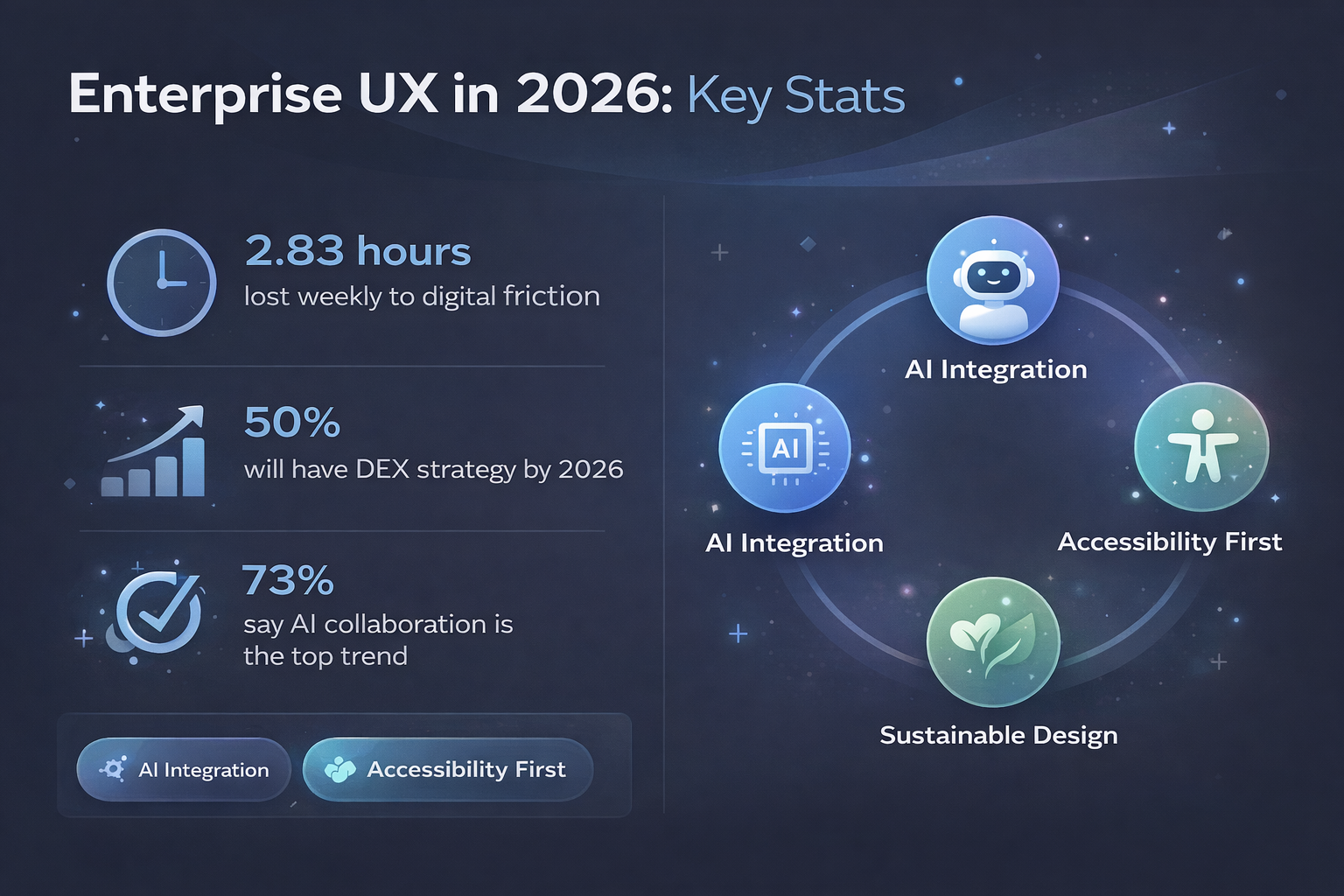
According to Gartner, digital employee experience (DEX) is now a transformation lever for IT teams. Companies that invest in better enterprise UX see measurable improvements in productivity, employee satisfaction, and operational efficiency.
Here is what the research shows:
Employees lose an average of 2.83 hours per week due to digital friction. That is time wasted fighting with tools instead of doing meaningful work. Multiply that across your entire workforce, and the cost adds up fast.
By 2026, 50% of digital workplace leaders will have established a DEX strategy. This is not a nice to have anymore. It is becoming standard practice for competitive organizations.
For B2B SaaS companies building products for enterprise customers, this creates both a challenge and an opportunity. Your users expect your software to be as intuitive as the consumer apps they use every day. Meet that expectation, and you win loyalty. Fall short, and they will start looking for alternatives.
The Shift from Functional to Outcome Driven Design
The days of clunky enterprise software with steep learning curves are ending. In 2026, enterprise UX design is moving away from purely functional interfaces toward designs that deliver measurable outcomes.
What does this mean in practice?
Modern enterprise UX focuses on helping users complete tasks faster with less effort. The goal is not just to provide features. It is to reduce cognitive load and guide users toward their objectives.
Think about how tools like Notion and Slack have changed expectations. They combine powerful functionality with interfaces that feel simple and intuitive. Enterprise software buyers now expect similar experiences from B2B products.
This shift requires a different approach to Webflow UX design and development. Instead of cramming every feature onto the screen, smart teams prioritize clarity over complexity. They reveal information progressively, showing users what they need when they need it.
Progressive disclosure is becoming essential. Complex dashboards no longer dump all information on users at once. Instead, they show the most important actions first. Advanced features remain accessible without creating clutter. This approach improves usability for both new and experienced users.

Visual design in 2026 emphasizes calmness and clarity. Interfaces are adopting larger typography, softer edges, increased spacing, and thoughtful color contrast. These choices improve readability and reduce visual fatigue during long work sessions.
The focus has shifted from novelty to usefulness. Design teams now measure success by task completion rates and user satisfaction, not by how many animations they can add.
AI as a Collaborative Partner
AI is reshaping enterprise UX in ways that go far beyond chatbots. In 2026, AI works alongside users as a helpful partner, not a replacement.
According to a Lyssna survey, 73% of designers believe AI as a design collaborator will have the biggest impact in 2026. But the emphasis is clear. AI is there to help users do better work, not to do the work for them.
Here is how AI is transforming digital workplaces:
Role based AI agents are becoming more common. Instead of generic assistants, enterprises are deploying AI that understands specific job functions. A sales team might have an AI that drafts follow up emails based on meeting notes. A support team might have one that suggests relevant knowledge base articles.
Predictive interfaces anticipate what users need before they ask. Enterprise dashboards adjust layouts based on user behavior. SaaS platforms surface the most relevant actions automatically. Customer journeys feel guided rather than overwhelming.
Agentic AI is another emerging trend. These are AI systems that work on your behalf in the background to complete tasks over time. Imagine telling your enterprise tool to find the best vendor options while you focus on other work. The AI researches, compares, and presents findings when you are ready.
Generative UI is also gaining traction. Instead of static, predesigned screens, interfaces can adapt dynamically based on context. A dashboard might reorganize itself based on what the user is trying to accomplish. Forms might simplify or expand based on the information being entered.
The key is subtlety. Heavy handed AI feels invasive. Smart AI integration supports users without making them feel watched or controlled. Transparency matters too. Users want to know when AI is influencing what they see and have the ability to adjust settings.
For B2B companies building Webflow websites, this means designing experiences that can incorporate AI powered features seamlessly. Your website conversion optimization strategy should consider how AI can personalize the user journey without being creepy.
Accessibility as a Baseline, Not an Afterthought
Accessibility used to be something teams checked at the end of a project. That approach no longer works.
In 2026, inclusive design is a baseline expectation for enterprise products. The European Accessibility Act is already in force for new products. The U.S. is progressing updates to the ADA for digital environments. Australia, Canada, India, and Brazil are strengthening their requirements too.
For enterprise UX design, this means building accessibility in from the start. You cannot bolt it on later and expect good results.
Here is what accessibility first design looks like:
Clear navigation structures that work with screen readers. Adequate color contrast that helps users with visual impairments. Keyboard navigation that does not rely on a mouse. Readable typography with appropriate sizing and spacing.
Compliance is important, but smart companies go beyond minimum requirements. They recognize that accessible design is simply better design.
Consider how accessible practices benefit everyone. Clear visual hierarchy helps users scan content faster. Simple navigation reduces confusion for any user. Consistent patterns make software easier to learn regardless of ability level.
The business case is strong too. Accessible UX improves usability for all users, not just those with disabilities. Larger touch targets help everyone on mobile. Organizations that prioritize accessibility also reduce legal risk and broaden their potential user base.
Designing for accessibility also future proofs your product. As regulations tighten globally, products built with accessibility in mind will require fewer costly retrofits. Companies that wait will face expensive redesigns and potential compliance issues.
Motion design is another area where accessibility matters. While animations can improve user experience, they can also cause problems for users with vestibular disorders. Modern enterprise UX respects reduced motion preferences and uses animation purposefully rather than gratuitously.
Accessibility-First Design Checklist
- Clear navigation structures that work with screen readers
- Adequate color contrast for users with visual impairments
- Keyboard navigation that does not rely on a mouse
- Readable typography with appropriate sizing and spacing
- Reduced motion preferences respected for vestibular disorders
- Purposeful animation that serves functionality over decoration
Context Aware Experiences Across Devices
Mobile first design is not new. But in 2026, enterprise UX goes further with context aware experiences.
Modern enterprise users switch between devices constantly. They check dashboards on phones during commutes. They work on laptops at desks. They review reports on tablets in meetings. They expect products to feel familiar everywhere.
This does not mean identical layouts on every screen. It means consistent logic and behavior that users do not have to relearn.
Multimodal interactions are also becoming standard. Users want the flexibility to use voice, touch, gesture, or text depending on their context. Someone cooking dinner might use voice commands. Someone in a quiet office might prefer typing. Good enterprise UX accommodates these different input modes seamlessly.
For Webflow UX transformation projects, this requires careful planning. You need to think about how navigation adapts across screen sizes. How forms simplify on mobile without losing functionality. How complex data visualizations translate to smaller displays.
Touch interactions deserve special attention. Mobile users interact through touch, not mouse clicks. Hover states do not exist on touch devices. You need alternative ways to convey interactivity, such as subtle animations or color changes that indicate touchable elements.
Form design for mobile also matters. Use appropriate input types for different kinds of information. Number pads for phone numbers. Email keyboards for email addresses. These small details reduce friction and improve completion rates.
The goal is reducing friction at every touchpoint. When users can move between devices without losing their place or having to relearn the interface, adoption and engagement improve. This consistency builds trust and reduces the learning curve for new users.
Sustainability in Digital Design
Sustainability is moving from nice to have to formalized expectation. The W3C Web Sustainability Guidelines are expected to be finalized in April 2026, defining best practices for designing planet friendly digital products.
This matters for enterprise UX because digital products have a carbon footprint. Heavy images, unnecessary animations, and bloated code all consume energy. At enterprise scale, these inefficiencies add up.
Sustainable enterprise UX design means:
Optimized images and efficient asset loading. Purposeful animations that serve functionality, not just decoration. Streamlined code that reduces server load. Low data modes for users with slower connections.
The good news is that sustainable design often aligns with performance goals. Faster loading pages create better user experiences. Efficient code reduces hosting costs. Cleaner interfaces improve usability.
For B2B SaaS companies, this is also a differentiator. Enterprise buyers increasingly care about their vendors' environmental impact. A sustainably designed website and product demonstrates values alignment.
The Rise of Digital Wellbeing
As enterprise products become more immersive, helping users maintain healthy digital habits is becoming a design responsibility.
In 2026, enterprise UX considers how interfaces affect user wellbeing. This includes features like:
Work life balance reminders that encourage breaks. Notification management that reduces constant interruptions. Interfaces designed to reduce cognitive load. Focus modes that help users complete deep work.
Products that overwhelm users risk contributing to burnout and anxiety. Products that respect user time and attention build trust and loyalty.
This principle applies to B2B websites too. When you design user experiences for your Webflow site, consider how visitors will feel interacting with it. Dense walls of text and aggressive popups create stress. Clear layouts and helpful content create positive impressions.
Data Driven Design Decisions
Enterprise UX in 2026 relies heavily on data to guide iteration. Teams are not just guessing what users need. They are measuring, testing, and refining based on actual behavior.
This includes:
Analytics that track how users interact with interfaces. Heatmaps that show where attention focuses. User research that uncovers pain points and opportunities. A/B testing that validates design decisions.
The shift is from designing once to continuous optimization. Enterprise UX becomes an ongoing effort, not a one time project.
Real time data is becoming central to this approach. Modern UX tools can track user behavior as it happens, identifying friction points and opportunities for improvement. This enables faster iteration cycles and more responsive design processes.
User feedback loops are also evolving. Instead of annual surveys, companies are implementing continuous listening approaches. These help identify pain points as they arise, enabling agile improvements to tools and workflows.
For enterprise products, this data driven approach helps balance depth of functionality with ease of use. By understanding how different user segments interact with features, teams can design role based interfaces that serve diverse needs without overwhelming anyone.
The key insight is that UX optimization never really ends. User expectations evolve. New features get added. Team compositions change. Data driven design ensures your product keeps pace with these shifts rather than slowly becoming outdated.
For B2B SaaS companies, this approach applies to marketing websites too. Your website should evolve based on how visitors actually behave, not assumptions about what they want. Conversion data, scroll depth, and engagement metrics all inform how you refine the experience over time.
How Flowtrix Approaches Enterprise UX
At Flowtrix, we help B2B SaaS, AI, and cybersecurity companies turn their websites into high converting Webflow experiences. As a certified Webflow Enterprise Partner and nominee for Webflow Partner of the Year 2025, we have worked with companies like Databahn, Akirolabs, Fuxam, Wayground, and Monk-E across the US, UK, Europe, and Middle East.
Our approach to enterprise UX combines:
Deep user research to understand how your customers actually work. Strategy that aligns UX decisions with business outcomes. CRO focused design that drives demo bookings and conversions. Technical SEO foundations that help you get found. Webflow Enterprise development with clean, scalable architecture.
We do not just make websites look good. We make them work harder for your business.
If you are building products for enterprise customers, your marketing website needs to reflect the same UX standards you bring to your product. A confusing website creates doubt about your product quality.
What This Means for Your 2026 Strategy
Enterprise UX is evolving fast. The trends shaping 2026 point toward experiences that are smarter, more accessible, and more respectful of users.
For B2B SaaS companies, this creates clear priorities:
Invest in UX research to understand your users deeply. Design for accessibility from the start. Consider how AI can enhance rather than complicate experiences. Build sustainable, performant digital products. Measure and iterate based on real data.
The stakes are high. Companies that get enterprise UX right will see better adoption, higher retention, and stronger competitive positioning. Those that ignore these trends risk falling behind as user expectations continue to rise.
Start by auditing your current digital experiences. Where are users struggling? What tasks take longer than they should? Which features go unused because they are too hard to find? These insights guide where to focus improvement efforts.
Consider your website as part of the enterprise UX equation. For B2B companies, the marketing website is often the first touchpoint in the customer journey. A confusing website creates doubt about product quality. A smooth, intuitive website builds confidence and sets expectations for the product experience.
Your website is often the first enterprise UX experience prospects have with your brand. Make it count.
Ready to transform your digital presence with enterprise grade UX? Contact Flowtrix to start the conversation.
FAQ's




.webp)




.svg)

.svg)



%201.svg)


.svg)
.svg)